Showing posts with label Duke of Wellington. Show all posts

Wednesday, February 26, 2014

Napoleon escaped Elba


199 years ago today, February 26, 1815, deposed Emperor of the French Republic, Napoleon, escaped Elba to return to France. When the New Orleans Expedition was offered to the Duke of Wellington the previous October, he declined the assignment, citing Napoleon was exiled on the small island of Elba and just might not stay there. He was right. Wellington's brother-in-law Sir Edward Pakenham accepted the assignment as Commander-in-chief of the New Orleans expedition, leaving England on November 1, 1814. Pakenham was killed at New Orleans on January 8, 1815, depriving Wellington the service of his favorite field commander. Wellington bemoaned the fact he sorely missed Ned Pakenham as he prepared for his climactic battle with Napoleon at Waterloo in June, 1815.

Saturday, January 18, 2014

The British Leave


January 18 and January 19, 1815

The British army leaves Louisiana. Gen. Lambert, needing re-supply, captures Mobile on February 12, 1815. He will be decorated later for his brilliant withdrawal of the defeated army. Although these British troops leave American dispirited and beaten, many of these veterans will see action at the titanic Battle of Waterloo on June 18, 1815, where, on the eve of the battle, the Duke of Wellington lamented the absence of his favorite field commander, Sir Edward Pakenham.

from BATTLE KISS, Part 4, “Aftermath” www.oneildenoux.net

Wednesday, January 8, 2014

THE BATTLE OF NEW ORLEANS, the battle ends

January 8, 1815

The Battle Ends – As the British withdraw to de la Ronde Plantation, Gen. Jackson is urged to pursue, destroy the British army. He does not rise to the bait. His job is not to destroy the British, but to protect New Orleans, which he has. NO – the British did not run through the brambles, rush through the bushes where the rabbits couldn’t go. They withdrew orderly and wait. Casualties on the British side are over 2,000. Eight Americans were killed at the Rodriguez Canal.

NOTE: Best friends Poul and Gérard went to the battle with Lucia’s kiss on their lips. Matthew passionately kissed his Aimée before joining Catoire who departed for the canal with a kiss from Tiffany, while Carmenbray has to pull himself away from his Elizabeth. One of these men is killed at the Rodriguez Canal, another severely wounded and clings to life. Of the three British brothers, Godfrey, William and Harold Lowe, only one emerges unscathed.

from BATTLE KISS, Part 3, “The Battle of New Orleans” www.oneildenoux.net

THE BATTLE OF NEW ORLEANS, at dawn

January 8, 1815

AT DAWN. Gen. Pakenham realizes his west bank attack will be only a diversion as most of the cannons and only part of his force is able to cross the Mississippi. He is unaware that the men with the fascines (to fill the canal in front of the American line) and the ladders are NOT in front of his troops. He has 8,000 men hidden in fog, within range of US artillery. Gen Jackson’s 4,000 Americans watch and wait. Just before 6 a.m., a signal rocket rises into the gray sky from the British line and the wail of bagpipes echoes across the Chalmette Plantation, along with the steady beat of drums. They are coming!


from BATTLE KISS, Part 3, “The Battle of New Orleans” www.oneildenoux.net

Thursday, December 26, 2013

Clarification

In my Christmas posting beneath the image of Gen. Pakenham, I put the following:


Sir Edward Michael Pakenham
brevet Lt. General, Commander-in-Chief of the New Orleans Expedition
Future British Royal Governor of Louisiana
Brother-in-law of the Duke of Wellington


When Gen. Pakenham departed England for the campaign to capture New Orleans on November 1, 1814, he carried a decree proclaiming him Royal Governor of Louisiana. That is why I listed it under his image. To the British he was the future governor. It was contingent on his capturing New Orleans, of course. And we all know how that turned out

Sorry for the confusion.
De Noux

Monday, December 23, 2013

The Night Battle – second engagement of the Battle of New Orleans


December 23, 1814

12:22 a.m., Royal Marines capture most of the US detachment at Fisherman’s Village where Admiral Cochrane raises his flag on American soil. Exhausted seamen continue rowing as the army begins moving along bayous and canals through the swamp.

7:12 a.m., green clad British riflemen and Royal Marines arrive at the Villére plantation where the first shot is fired by Louisiana militaman Lt. Bachot before the lone company of Louisiana militia is overwhelmed by the British. Maj. Villére manages to escape.
A furious General Andrew Jackson gathers his available troops. The goddamn British have come through the back door. The damn canals were NOT blocked. Jackson is surprised to learn the British have stopped and set up camp. After freezing days and nights on Pea Island and after a sixty mile trek in row boats over open water, the British troops are too exhausted to continue. The men collapse on dry ground, some starting fires, others scavenging for food. Jackson will attack immediately with USS CAROLINA and every available man.

In darkness, at 7:30 p.m. USS CAROLINA opens up on the British camp as a three prong attack by the Americans sends the British reeling. However, these are Wellington’s Heroes and the British rally as more troops arrive through the swamp and the bloody fight is a stalemate. The Americans fall back but have bloodied the British.

from BATTLE KISS, Part 2, “The British Invade” www.oneildenoux.net


Wednesday, December 11, 2013

December 11, 1814

The temperature drops considerably and a brisk wind blows across the flat land of south Louisiana as Gen. Jackson inspects Gentilly. This is the most direct route to the city. Artillery redoubts are begin constructed to hopefully bottle up the British but the ground here is open, flat and dry. Fort Petite Coquilles at the Rigolets Pass has been fortified with additional cannons. Thankfully British warships cannot get close due to the shallowness of Lake Borgne, but the British are known for amphibious landings. Jackson plans to focus his army within striking distance of Gentilly. Damn, he does not want to meet the British in an open battle. Wellington’s Heroes defeated Napoleon’s troops, didn’t they?


from BATTLE KISS, Part 2, “The British Invade” www.oneildenoux.net

Wednesday, November 27, 2013


November 27, 1814

New Orleans – British spies are working hard, learning the disposition of forts around the city and the small mosquito fleet on Lake Borgne. The Americans are aware of spy Harold Lowe, but Capt. Carmenbray explains you do not kill a spy. You feed him misinformation. If you kill him, the enemy will send another you do not know.

from BATTLE KISS, Part 1, “The Redcoats are Coming” www.oneildenoux.net

Saturday, November 23, 2013

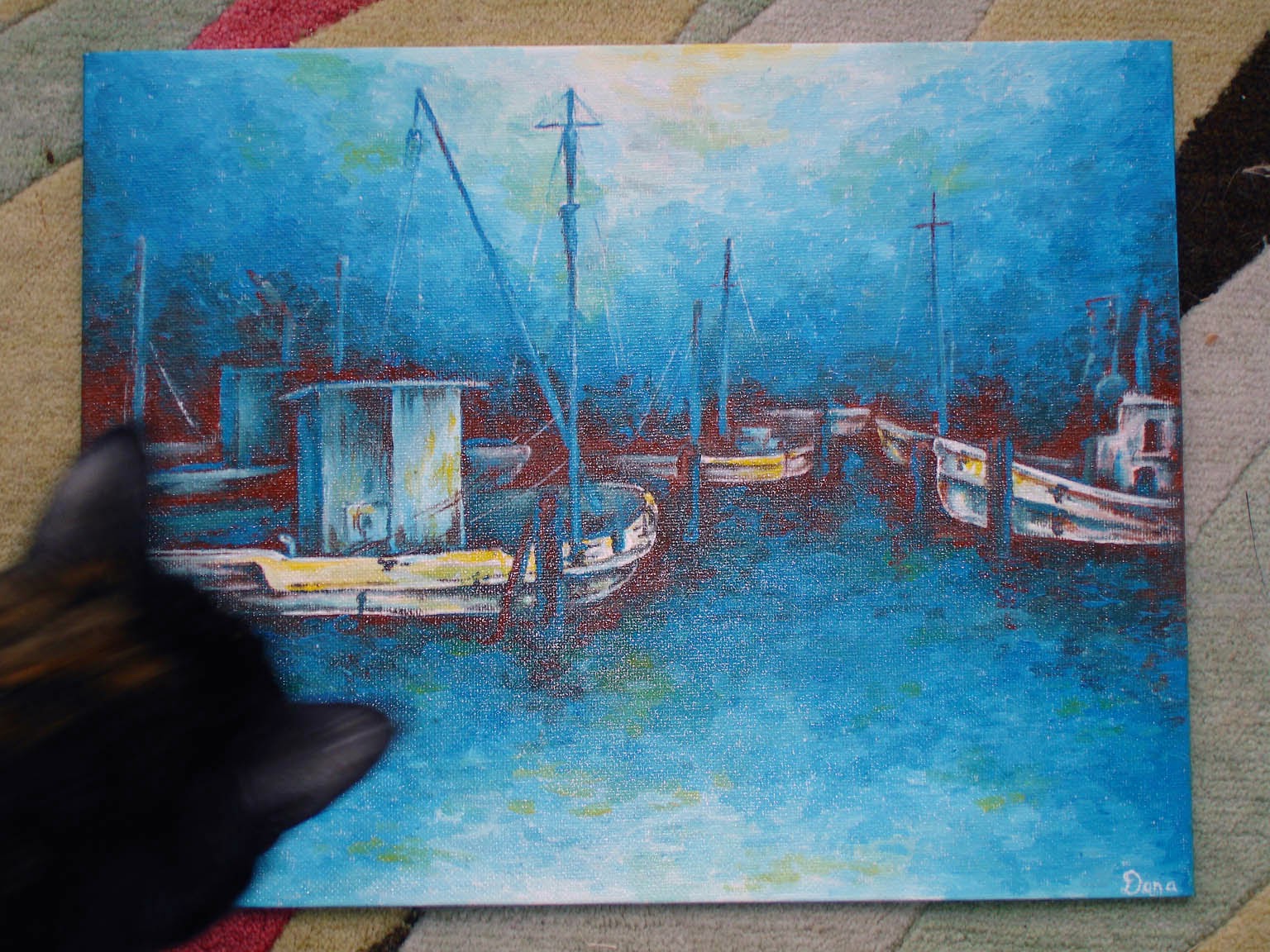
Photo of painting of shrimp boats by Dana De Noux, photobombed by cat

November 23, 1814

Atlantic Ocean – The American armed schooner shadowing HMS Statira keeps signaling, which draws the captain of the frigate carrying the high command of the New Orleans expedition to take evasive maneuvers, slowing down Gen. Pakenham’s journey across the ocean. Is one of the large American frigates nearby? Is the super frigate USS Relentless approaching?

As the Commander-in-Chief (CIC) of the expedition, Gen. Pakenham tries to convince the captain to stop maneuvering and head straight for Jamaica. He is reminded the captain of HMS Statira’s orders are to deliver the general and his staff safely to Jamaica and the captain of the ship is in command of the ship. This particular navy captain will no got down in history as the fool who allowed a CIC to be captured by the enemy before the invasion starts.

from BATTLE KISS, Part 1, “The Redcoats are Coming” www.oneildenoux.net

Friday, November 22, 2013

Breadfruit tree on Jamaica

November 22, 1814

Jamaica – Admiral Cochrane arrives at this British island and Major General John Keane, who has been assembling portions of the invading army from North America and the Caribbean, awaits the admiral. Keane is a veteran of Britain’s bloody Peninsula War against Napoleon’s armies. A young man at 33, Keane is not anxious to deal with bombastic, megalomaniacal Cochrane. Keane bemoans the fact Gen. Pakenham has yet to arrive.

Mobile – After his victory at Pensacola, Gen. Andrew Jackson stops in Mobile to shore up his defenses. This morning he starts his army marching overland to New Orleans.

from BATTLE KISS, Part 1, “The Redcoats are Coming” www.oneildenoux.net

Wednesday, November 20, 2013

Jamaica today

November 19, 1814

Negril Bay, Jamaica – The British invasion army begins to assemble in Jamaica – regiments sent from Canada and Portsmouth, England; Genoa, Italy; Capetown at the Cape of Good Hope. Gen. Pakenham, is still at sea, stuck on HMS Statira and impatient with peace talks under way at Ghent, Belgium. His orders are to continue the invasion unless he receives orders otherwise from the Regent.
New Orleans – Harold Lowe’s spying gathers much information for the British, which he sends to the frigates blockading the mouth of the Mississippi River. His notes will be forwarded to the fleet at Jamaica.
from BATTLE KISS, Part 1, “The Redcoats are Coming” www.oneildenoux.net

November 20, 1814

New Orleans – Americans are increasing in numbers and becoming an economic power in the city. Creoles bemoan the inevitable fact that their beloved European city is being transformed into a U.S. town. When the Spanish took over the city from the French, the language and customs remained French. Now English is becoming the dominate language. The brash, crass, Kaintucks are beginning to outnumber Creole gentlemen. And now the Americans bring their war here. Damn.
from BATTLE KISS, Part 1, “The Redcoats are Coming” www.oneildenoux.net